Sources:
http://hlgenterprise.com/images_template1/Alfa$205litres.jpg - Vegetable Oil
http://www.chericherie.com/cosmetics_front.jpg - Cosmetics
When you look at the items shown above, what do they all have in common?
You guessed it, Palm Oil.
 |
Palm Oil is oil obtained from the fruits of a Palm Oil Tree, and processed to be used in food, biofuels, cosmetics, and other products known to serve or benefit humans. Therefore, palm oil is very useful for our economy and our wellbeing.
However, did you know that three years ago in Malaysia and Indonesia, they had about 129, 000- square kilometers of Tropical soil lowland areas— covered by Oil Palm tree plantations? In addition to that, these areas in Southeast Asia previously had vast areas of tropical rainforests that supported habitats, and food for many of Earth’s endangered wildlife species in the area.
Now, what is the term used when humans permanently remove trees from an area of land for reasons, such as commercial usage? DEFORESTATION!
You may have learned back in grade 7 Science about the harsh effects of deforestation, and the damage it does to our ecosystem. Unfortunately, deforestation is continually spreading fast in many rich, tropical rainforest areas in the world, and it is because of people’s lifestyles and manufacturers' and government officials' desires for wealth, and power.
Article:
Article:
Oil Palm Plantations Are No Substitute For Tropical Rainforests, New Study Shows
ScienceDaily (Sep. 17, 2008) — The continued expansion of oil palm plantations will worsen the dual environmental crises of climate change and biodiversity loss, unless rainforests are better protected, warn scientists in the most comprehensive review of the subject to date.
Lead author, Emily Fitzherbert from the Zoological Society of London and University of East Anglia
Palm oil, used in food, cosmetics, biofuels and other products, is now the world's leading vegetable oil. It is derived from the fruit of the oil palm, grown on more than 50,000-square miles of moist, tropical lowland areas, mostly in Malaysia Indonesia
The review, published September 15 in the journal Trends in Ecology and Evolution, singles out deforestation associated with plantation development as by far the biggest ecological impact, but finds that the links between the two are often much more complex than portrayed in the popular press.
Co-author Matt Struebig, from Queen Mary, University of London
Within countries, oil palm is usually grown in a few productive areas, but it looks set to spread further. Demand is increasing rapidly and 'its potential as a future agent of deforestation is enormous', the study says.
Most of the suitable land left is within the last remaining large areas of tropical rainforest in Central Africa , Latin America and Southeast Asia . Where oil palm has replaced tropical forest the impact on wildlife depends on what species survive in the new oil palm habitat.
The study confirmed that oil palm is a poor substitute habitat for the majority of tropical forest species, particularly forest specialists and those of conservation concern.
Emily Fitzherbert continues: "By compiling scientific studies of birds, bats, ants and other species, we were able to show that on average, fewer than one-sixth of the species recorded in primary forest were found in oil palm. Degraded forest, and even alternative crops such as rubber and cocoa, supported higher numbers of species than oil palm plantations."
Even this estimate is likely to be optimistic, because forest habitats are more difficult to survey and some species inhabit plantations briefly before going extinct.
There is little potential to help wildlife within plantations, so ensuring that new plantations do not replace forest and protecting what is left of native forest in and around plantations are the only real options for protecting the majority of species, the researchers say.
International policies demanding evidence of environmental responsibility, in particular that land of high conservation value is not converted to oil palm, can help.
"There is enough non-forested land suitable for plantation development to allow large increases in production without further deforestation," said co-author Ben Phalan, from the University of Cambridge
However, in identifying these areas, there needs to be a careful distinction between degraded land that is of low conservation value, such as imperata grasslands, and partially logged or degraded forest areas which can still harbour relatively high levels of biodiversity and bring greater wildlife and carbon storage benefits if restored.
"Unless governments in producer countries show stronger leadership in controlling logging, protecting forests and ensuring that crops are planted only in appropriate areas, the impacts of oil palm expansion on biodiversity will be substantial," adds Phalan.
This study is released as pressure mounts on UK UK UK UK
While increases in biofuel use will almost certainly add to pressure on tropical forests, the study highlights how those pressures might be reduced.
A recent initiative, the Roundtable on Sustainable Palm Oil, has encouraged 40 per cent of the palm oil industry to commit to saving wildlife on and around plantations. The scientists hope that the Roundtable will continue to attract many of the remaining 60 per cent.
In Indonesia
These initiatives will help, but the study warns that unless they are scaled up and better supported by stronger government action against deforestation, damage to rainforests and their unique wildlife will continue.
Source:
My view:
So this article is basically about Emily Fitzherbert from Zoological Society of London and University of Anglica (leading author of this Science Daily article), who is raising awareness to people about the harsh effects of growing, and harvesting oil palm trees in areas of tropical rainforests. According to the article, palm oil plantations are degrading the rainforests, and it is due to palm oil trees having less resources to offer for animals to survive.
Palm Oil trees are poor substitutes for many wildlife animals living in tropical rainforests because their bodies have already been accustomed to the excellent food, and the habitats rainforests offers to them. I mean, the only resource palm oil trees offer to animals are their fruits, which is not enough for wildlife animals to survive. Furthermore, palm oil plantations filter less carbon dioxide because humans use palm oil trees for their fruits and discard them afterwards. On the other hand, rainforests offers a wide variety of foods, such as ananas, nuts, With that being said, scientists suggests that manufacturing countries should create organizations that will do a particular work, such as protect the forests, control further logging, and become more selective as to which areas are appropriate for commercial usage. In addition, manufacturing countries should take this matter seriously by improving, and maintaining the tropical rainforest areas, which would help save the wildlife animals that live in the area, and the environment from climate change.
Nevertheless, I believe this is an unbiased article because the author, is not only informing the readers about the negative effects of palm oil plantations. She also talks about what the locals are trying to do to save their tropical rainforests, and reassures the readers that there are enough non-forested lands to support the locals’ economy and lifestyles. Furthermore, I believe the author understands the significance of palm oil production because on the article she states, "Palm oil, used in food, cosmetics, biofuels and other products, is now the world's leading vegetable oil.” Furthermore, there is a statement from the co-author of the article, Ben Phalan from University of Cambridge who informs the readers that, "There is enough non-forested land suitable for plantation development to allow large increases in production without further deforestation." Ben Phalan is already aware that high demands of palm oil means more palm oil plantations to establish. However, he wants to let the readers and palm oil industries know, that they don't have to use tropical rainforests to establish a palm oil business. They can use degraded lands that have low conservation value as their area of business.
Lastly, I found this article via Science Daily, which is a reliable source for latest research news. Furthermore, the leading author is from Zoological Society of London and studied in University of Anglica, and the co-authors such as, Ben Phalan is from University of Cambridge. Nonetheless, the accuracy of this article’s information is accurate—three years ago. However, todayMalaysia and Indonesia South Africa
Lastly, I found this article via Science Daily, which is a reliable source for latest research news. Furthermore, the leading author is from Zoological Society of London and studied in University of Anglica, and the co-authors such as, Ben Phalan is from University of Cambridge. Nonetheless, the accuracy of this article’s information is accurate—three years ago. However, today
Sources:
(1) Bernama. "Malaysia To Discuss Tax Cut For Palm Oil Export With Indonesia." Malaysian National News Agency Bernama.com, October 06, 2011. Web. October 11, 2011. <http://www.bernama.com.my/bernama/v5/newsbusiness.php?id=618078>.
(2) Butler, Rhett and Hance, Jeremy. "A Huge Oil Palm Plantation." Environment 360, Sept. 12, 2011. Web. October 11, 2011. <http://e360.yale.edu/feature/huge_oil_palm_plantation_puts_africa_rainforest_at_risk/2441/>.
Sustainable Oil Palm?
This video shows the industrial palm oil issue, but it does not show solutions for how consumers can prevent further deforestation in
According to Greenpeace, RSPO gives certification standards that would make their palm oil more “sustainable,” and environmentally-friendly. However, they also stated on their website that, "The aim of the group is to create clear standards for producing sustainable palm oil but at present those standards are far too weak to ensure that forests and peatlands are not destroyed to meet growing demand for palm oil."(2) Therefore, RSPO really can't save the tropical rainforests because the standards are too weak, for palm oil plantations to follow. Nevertheless, my question is, can palm oil really be sustainable? Personally, palm oil has many likes and one of them is they like when they're grown in a rich, damp tropical lowland soil. However, what they do with the rich, damp tropical lowland soil is that they use all the soils' nutrients, produce the fruits, and destroys them afterwards, hence cannot be defined as “sustainable.”
Extinction
There are many orangutans living in Indonesia and Malaysia, that are harshly affected by the large numbers of palm oil being grown, and harvested in tropical rainforest areas. Due to this scenario, in 1900 there were about 315, 000 orangutans that lived in the wild. However, today there are only less than 50, 000 that exist in the wild, and it is because of palm oil production replacing the orangutans' habitats.(5)
Extinction
 | |
| Link of this picture. |
Heart disease?
 |
| http://topnews.in/health/files/No-Exercise-Long.jpg |
Sources:
(1) "Forests - The Palm Oil Threat." October 31, 2006. Youtube. Web. October 11, 2011. <http://www.youtube.com/watch?v=y7fFeJyXkBk>.
(2) Greenpeace. "Palm oil: Cooking the Climate. Once you pop, you can't stop." Greenpeace Canada. Web. November 13, 2007. October 11, 2011. <http://www.greenpeace.org/canada/en/campaigns/boreal/archive/recent-developments/palm-oil-cooking-the-climate/>.
(3) USDA/Agricultural Research Service. "Palm Oil Not A Healthy Substitute For Trans Fats, Study Finds." ScienceDaily, 11 May 2009. Web. 11 Oct. 2011. <http://www.sciencedaily.com/releases/2009/05/090502084827.htm>.
(4) Dr. Oz. "Dr. Oz's 99-second Healthy Eating Plan." Dr. Oz show, September 29, 2009. Web. October 11, 2011. <http://www.doctoroz.com/videos/dr-ozs-99-second-healthy-eating-plan>.
(5) Roundtable on Sustainable Palm Oil. "Environmental impact of palm oil production." GreenPalm Sustainability. Web. October 12, 2011. <http://www.greenpalm.org/en/about-palm-oil/environmental-impact>.
(6) Ashley Schaeffer. "What is Sustainable Palm Oil? Part One." The Understory of all the dirt that's fit to post. Web. June 22, 2011. October 11, 2011. <http://understory.ran.org/2011/06/22/what-is-sustainable-palm-oil-part-one-of-a-three-part-series/>.
(6) Ashley Schaeffer. "What is Sustainable Palm Oil? Part One." The Understory of all the dirt that's fit to post. Web. June 22, 2011. October 11, 2011. <http://understory.ran.org/2011/06/22/what-is-sustainable-palm-oil-part-one-of-a-three-part-series/>.
Conclusion:

We know for a fact that Palm Oil plantations help increase the economy of developing countries, such as Malaysia and Indonesia
I mean, we may think we don’t necessarily need rainforests but without the wonderful trees that rainforests have, where will the land animals live? What will the wildlife animals eat? Without the wildlife animals, what will we, humans eat? What will happen to earth if all of a sudden, the whole rainforests are wiped out due to commercial usage, such as palm oil plantation? As many of you know, trees are living filters that help reduce amounts of CO2 (greenhouse gases), which produces air pollution. Air pollution affects animals, humans and certainly, our environment. If our planet has less tropical rainforests living on this earth, there would be less food for animals to eat, which means less food for humans to consume, and more air pollution since there are less rainforests to store carbon dioxide.
I mean, we may think we don’t necessarily need rainforests but without the wonderful trees that rainforests have, where will the land animals live? What will the wildlife animals eat? Without the wildlife animals, what will we, humans eat? What will happen to earth if all of a sudden, the whole rainforests are wiped out due to commercial usage, such as palm oil plantation? As many of you know, trees are living filters that help reduce amounts of CO2 (greenhouse gases), which produces air pollution. Air pollution affects animals, humans and certainly, our environment. If our planet has less tropical rainforests living on this earth, there would be less food for animals to eat, which means less food for humans to consume, and more air pollution since there are less rainforests to store carbon dioxide.
We don’t need to entirely remove all palm oil plantations because one, it is too late and two, all of us need it one way or another. However, producer countries need to be aware that they should not continue doing further logging, and removing trees in other forested areas, but wisely use the areas they have destroyed or carefully choose areas that are appropriate. But the problem is that reusing lands, selectively choosing areas, and reducing the amount of time and effort used to produce palm oil costs money, which will make some producer countries disagree. Though, I believe that the only way to solve this problem, is for consumers to become aware of palm oil plantations substituting rainforests. In addition, to use palm oil minimally than we ever did before.
Which do you prefer?
A lush, green, and rich tropical rainforest that supports wildlife the ecosystem, and our environment?
Or a green dessert of Oil Palm Plantations that are degrading the resources wildlife animals need to live?
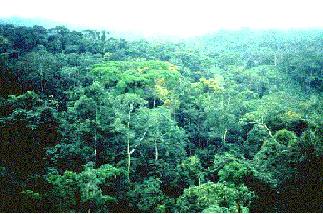 |
| Rainforest |
 |
| Oil Palm Plantation |
Sources:
http://www.peopleandplanet.net/image.php?id=1415 - Palm Oil Plantation